




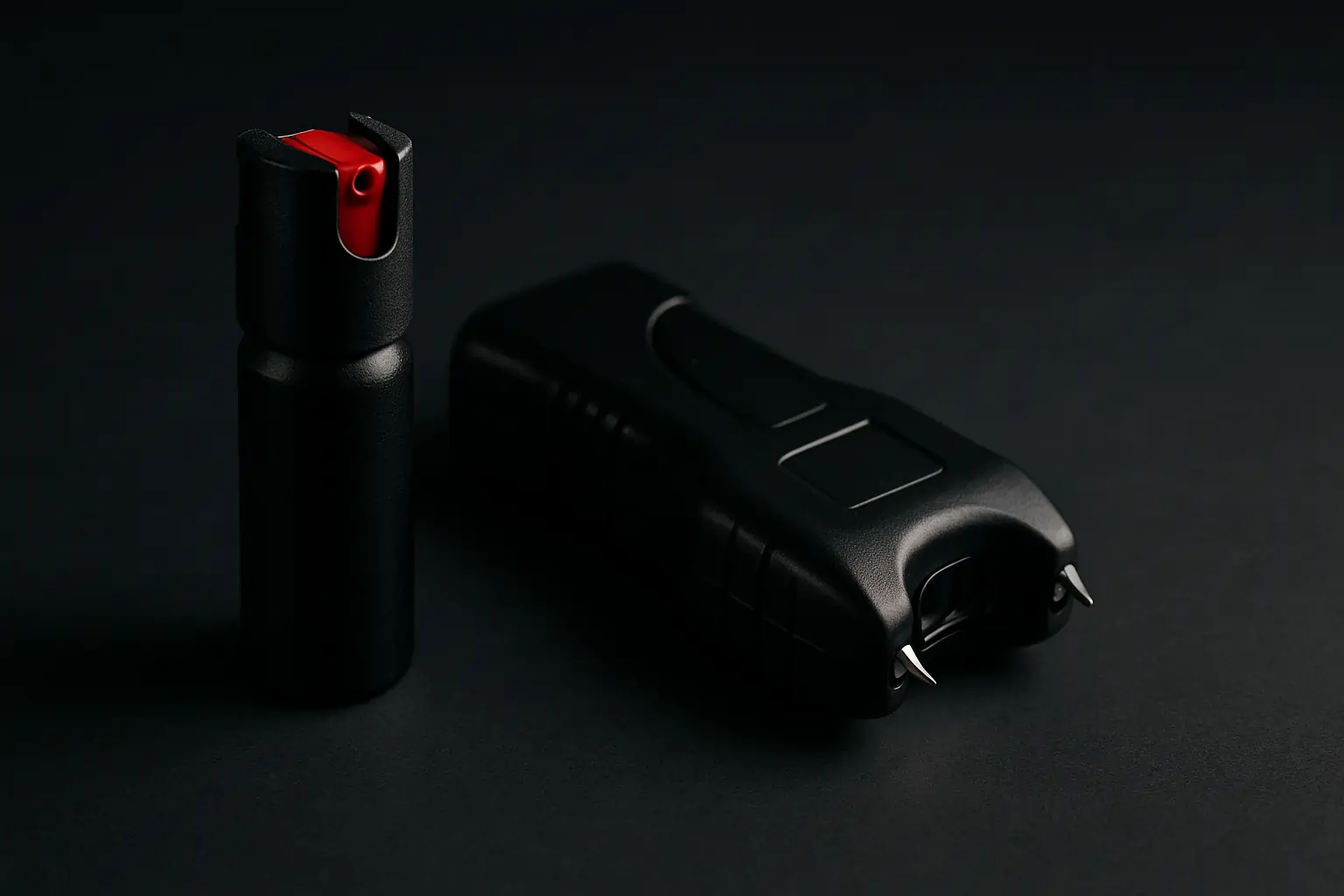
Choosing a personal safety tool should be simple. Most people want something small, legal where they live, easy to carry, and strong enough to stop an attacker long enough to get away. This guide explains the differences between pepper spray and stun guns in clear terms. It also shows why pepper spray is the more practical choice for most everyday situations.
Quick verdict
If you want a light, fast, distance based tool that does not require physical contact, choose pepper spray. It lets you disable from a few meters away and create space to escape. Stun guns can work, but they need direct contact, which is risky and harder under stress.
What pepper spray is and how it works
Pepper spray is a compact can with a safe cap and a press nozzle. The active ingredient is oleoresin capsicum, a natural chili extract. A short burst to the face causes intense burning, tearing, coughing, and temporary eye closure. Effects start in seconds and usually last long enough for you to move away and find help. Modern units are pocket sized, simple to aim, and designed for quick use.
Strengths of pepper spray
- Works at a distance. Typical reach is a few meters.
- Quick to deploy. Point, press, move.
- Light and discreet. Easy to carry daily on a keychain or in a pocket.
- Non lethal. Strong effects that wear off.
Limits to keep in mind
- Wind can push a mist back toward you. Gel types reduce this.
- You still need basic awareness and a plan to move away.
What a stun gun is and how it works
A stun gun is a handheld device that uses electric contact points to deliver a shock when pressed against an attacker. It aims to cause pain and muscle interruption. Some devices look like small flashlights. To use one, you must close distance and hold contact on the target.
Strengths of stun guns
- Can stop someone fast at close range.
- Not affected by wind.
Limits to keep in mind
- Requires contact. You must be within arm’s reach.
- Easy to fumble in a struggle.
- Larger and less convenient for daily carry than a tiny spray.
- Legal status varies and can be stricter than sprays in many places.
Head to head comparison
| Factor | Pepper spray | Stun gun |
|---|---|---|
| Distance | A few meters | Must touch the attacker |
| Speed to use | Very fast, point and press | Fast, but must make contact |
| Risk to user | Lower, you keep space | Higher, you enter grappling range |
| Size and carry | Keychain friendly | Often bulkier |
| Multiple attackers | Better, can create a barrier | Hard, requires contact per person |
| Wind or enclosed spaces | Wind can matter. Gel reduces blowback | Wind does not matter |
| Learning curve | Simple practice routine | Must be calm at zero distance |
When pepper spray is the smarter choice
- You walk, jog, or commute and want something ready in your hand without drawing attention.
- You want distance. You prefer not to wrestle at arm’s length.
- You want a tool that is fast to present and simple to use under stress.
- You want a compact option you will actually carry every day.
Common mistakes and how to avoid them
- Digging in a bag during a threat. Carry your spray where your hand reaches it in one move.
- Spraying into the wind. If you can, step so the wind carries the spray toward the threat. Consider gel sprays to reduce blowback.
- Over-spraying in one long stream. Use short bursts, then move.
- No practice. Practice the motion of unlocking the safety, aiming, and pressing a short burst. Use an inert trainer if you have one.
- Letting it expire. Check the date, replace on schedule, and store away from heat and freezing.
How to choose the right pepper spray
You want a reliable unit that fits your routine. suzavci.com sells different formats so you can match your use case.
Pick a spray pattern
- Stream: longer reach and less airborne drift. Good for outdoors.
- Gel: sticks to the target and reduces blowback. Good for wind and indoor use.
- Foam: heavy output that clings and limits spread. Good in tight spaces.
Pick a form factor
- Keychain mini: always with you. Best for daily carry.
- Jogger strap: sits on your hand while running.
- Compact pocket or purse can: a bit more capacity for repeated bursts.
Practical features to look for
- Flip top or twist safety that you can operate by feel.
- Enough bursts for realistic scenarios.
- Visible color or a holder so you can find it fast in a bag.
- Clear expiry date.
Safety and legal notes
Only use pepper spray in genuine self defense. Keep out of children’s reach. Check your local rules before carrying. Do not take pepper spray on planes. If you use it to stop a threat, move to safety and call the police.
FAQs
Is pepper spray good for beginners?
Yes. It is simple to learn. Practice the safety, aim at the face, press a short burst, move away.
Will it work on someone larger than me?
Yes. Size does not block eye and airway irritation. Some people resist for a moment, so be ready to move and, if needed, spray again.
What about wind or indoors?
Wind can push a mist back. Gel reduces this. Indoors, all sprays can affect the room, so use short bursts and exit quickly.
How long does a can last?
Most cans have an expiry date set by the maker. Replace on time. Store at room temperature.
The bottom line
Both tools can stop an attacker. Pepper spray does it at a safer distance with less complexity. That is why it fits more daily lives and why most people who will actually carry something choose a spray.
Ready to choose your spray?
- Keychain minis for everyday carry
- Gel options for wind and indoor use
- Jogger straps for running
Browse our selection and pick the format that fits your routine.
Visit suzavci.com and find your pepper spray today.


